
Museo Nacional Centro de Arte Reina Sofia Santa Isabel, 52 28012 Madrid Espagne
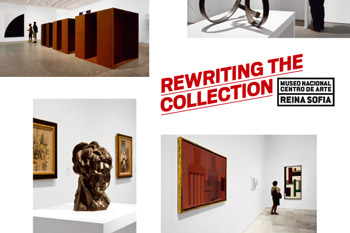
A museum's collection intrinsically traces notions of history and time. But what history or histories do we tell? We are aware that, traditionally, museums have been trapped within a canonical view of history that seeks to establish sequential order between time periods. This traditional approach aims to explain works of art with documents and testimonies from an era without understanding that the images and objects far surpass the circumstances from which they were born. In this light, this approach fails to understand that time is not a past time, but the time of memory, which the historian interpellates insofar as this memory contains heterogeneous times.
We reclaim a space for critiquing history while upholding the value of narrating the past, not as a means to discover "the way it really was," but, following Benjamin, to seize hold of memory in the present state of emergency "when it flashes up at a moment of danger," thereby "wresting tradition away from a conformism that is about to overpower it." This history materializes in a web of open-ended, fragmentary narratives that speak to us of hands, gazes and minds, all of them synchronized at one moment, crystallizing into an image, an object or a document. Above all else, this narrative involves conveying and activating experiences—experiences that refer to a past time and yet remain in the present, ones that can only be perceived from the present. Its end is not to find an escape route, but to enrich reflecting on experience, a kind of learning that does not stem from indoctrination, but from activating the ability to respond critically to the world and, of course, to the museum itself.
This position implicitly entails the need to create a new vocabulary, a new nomenclature. The Greek tragedies taught us that children bear their parents' burden, or just the same, that we are born with a destiny predetermined by a language and social structure that shape it. But it is also true that we can rewrite our own history, even though in order to do so we must forge new concepts that allow us to apprehend and explain a different reality. The museum has chosen to distance itself from the linear narratives of modernity, as they have traditionally been exhibited, but also from the banal oblivion of postmodernist history, evident in new exhibition models. We have also wanted to distance ourselves from conventional distinctions between center and periphery, thereby attending to the complexity of relationships established between the local and universal. In the following itinerary, we propose four large sections that follow a historical sequence, without wishing to impose a strict chronological order upon them. These groupings propose alternative routes and lines of flight that leave the narrative open-ended. In this manner, visitors are invited to create their own routes and form their own interpretations